Snow crystals are born in the clouds when water vapor freezes on a particle of dust, a floating bit of bacteria, or another solid material.
When cloud temperatures are at the freezing point or below, and there is an ample supply of
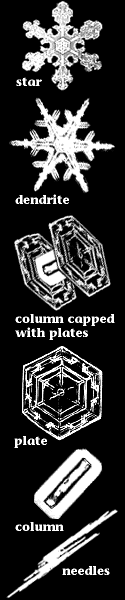
Snow can be further classified into six basic patterns called: Needles,columns, plates, columns capped with plates, dendrites, and stars. Eachtype is the result of different atmospheric and temperature conditionswithin the cloud.
While no two snowflakes are alike, they can be generally classified into six basic patterns pictured at the left. Each type of flake is a result of unique atmospheric conditions present at the crystal's birth. Think of them as a kind of "cloud diary" and a record of conditions aloft.
Snow Crystals
 Star
Star
Star crystals are born at temperatures near -15 degrees C, and are among the most common type of snowflakes. They are as delicate as theylook, and superstars are rare, because large flakes tend to become brokenby wind and midair collisions with other crystals. Under ideal conditionsseveral stars my join to form a larger snowflakes. The largest snowflakeon record was reported to be a whopping 8" by 12" (about the size of asheet of typing paper). It was reported to have fallen, probably with athud, in Bratsk, Siberia in 1971.
Dendrite
Dendrites are stars with attitude. Essentially, they are three dimensionalstar crystals with branches growing on more than a single plane. Branches(or arms) connect randomly to a central structure. These complex crittersform under extremely cold conditions (-20 to -25 degrees C) when high levelsof atmospheric moisture are present.
Columns
Columns are produced when the air is dryer. They are generally smaller,have a higher density than star crystals, and form over a wide rangeof temperatures (15 to -25 degrees C).
Plate
Plates are wanna-be stars that are essentially moisture starved. Theyform at temperatures of -10 to -20 degrees C when there isn't enough atmosphericwater vapor available to form the delicate arms of a classic star.
Column capped with plates
Capped columns are composite flakes formed when the particle of snowpasses through different temperature and moisture zones on its journeyto the ground. The columns form first, usually at higher and dryerregions of a cloud, and combine with star flakes as they fall throughlower and wetter cloud elevations.
Needles
Needles are formed at the upper end of the temperature spectrum, usuallywhen ground temperatures are at or near the freezing point. To grow,these crystals need an air temperature in the -5 to -10 degreesC range. Needles tend to produce a dense, stiff snow pack which can producean avalanche under the right conditions.
Did you know?
The greatest North American snow storm in history occurred on Feb. 13–19, 1959 when 15 feet, 8 inches of snow fell in a single snow storm at Mt. Shasta Ski Bowl, Calif. For more snowfall records, see Greatest Snowfalls.
Provided by .