The astrological phenomenon known as a solar eclipse has intrigued wordsmiths from the earliest ages of humanity. From the ancient Mesopotamian land of Ur to the contemporary seven-day festival culminating on August 11, 1999, in Cornwall, England, the sudden darkening of the sky and blotting out of the Sun has cast a long shadow of fear, suspicion, and wonder on the imaginations of poets and astronomers alike.
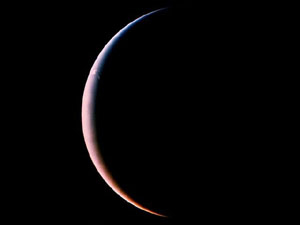
Eclipses have played an important part in literature from the early Chinese poets to Milton and Twain.
A grim omen
The first recorded occurrence of an eclipse was from Babylonian times, likely as early as the 21st century BC. Tablets from Ur contained omina, or detailed warnings, which associated the occurrence of an eclipse on a particular day with great catastrophes such as family wrongdoing or even the murder of a king.
The early Chinese had the same portentous outlook. As early as 1500 BC, inscribed turtle shells and oxen bones were found with references to an eclipse. The Chinese term chih translates into English as both "eclipse" and "eat," characterizing the common belief that a dragon was literally devouring the sun or the moon during an eclipse. This belief led to the tradition of beating drums and shooting arrows into the sky to frighten the dragon from its prey.
In the Shih ching, a Chinese classic poem from the 8th century BC, references are once again made to this fateful phenomena, and the royal astronomers Hsi and Ho are blamed for neglecting their duties in predicting this puzzling event.
The Greek poets took a more ponderous tack on the subject. "Change this worldwide portent into some painless blessing for Thebes," the poet Pindar wrote. His legacy reached Plutarch, who was particularly obsessed with the phenomenon and included references to both lunar and solar eclipses in his work Parallel Lives, written in AD100. One of Plutarch's characters, Lucius, is believed to have made the first known allusion to the solar corona.
No assembly today
During the Roman empire, the inherent fear of eclipses lessened somewhat, but just to be careful, Roman leaders would not hold a public assembly beneath an eclipsed sky. Cicero reported that the poet Quintus Ennius remarked, "On the nones of June the Sun was covered by the Moon and night." Ennius's reference is to the total solar eclipse of June 21, 400 BC, which occurred in Rome a few minutes after sunset.
Biblical references
References from the Bible to solar and lunar eclipses are numerous, including the passage from Amos 8:9, which reads, "'And on that day,' says the Lord God, 'I will make the Sun go down at non, and darken the Earth in broad daylight'." In addition, the destruction recorded in Revelations contains an allusion to the Sun becoming "black as sackcloth," and the Moon becoming blood.
'Birds fell whilst flying'
In medieval times, Islamic writers seemed intrigued with the correlating events of an eclipse. The Baghdad annalist Ibn al-Jawz wrote about the June 20, 1061, eclipse: "On Wednesday, when two nights remained to the completion of the month Jumada I [in AH 453], two hours after daybreak, the Sun was eclipsed totally. There was darkness and the birds fell whilst flying."
Milton's passion
"O dark, dark, dark, amid the blaze of noon,
Irrecoverably dark, total eclipse
Without all hope of day!"
- John Milton, Samson Agonistes
The English poet John Milton seemed particularly enamored with eclipses, including references in both Samson Agonistes and Paradise Lost. In the epic poem, he writes:
"As when the Sun, new risen,
Looks through the horizontal misty air,
Shorn of his beams, or from behind the Moon,
In dim eclipse, disastrous twilight sheds
On half the nations and with fear of change
Perplexes monarchs"
According to author Bryan Brewer in his book Eclipse, the monarch Milton refers to have been Charlemagne's son, Emperor Louis, and the eclipse may have been one that occurred on May 5, 840.
In Twain's Court
An eclipse is featured at the center of Mark Twain's A Connecticut Yankee in King Arthur's Court. Twain's protagonist, the mechanic Hank Morgan, is knocked unconscious and wakes to find himself back in the days of Camelot. He is condemned to death, but remembering that an eclipse was scheduled to occur on the day of his execution, he astounds his medieval captors by predicting its occurrence. His prophetic powers convince Camelot that he is a sorcerer, and they grant him clemency.
Informed by the fears and stories of previous generations, viewers of the last eclipse of the millennium may find new inspiration in this dazzling astrological phenomenon.
Return to Eclipse Index Page.
Sources: Encyclopedia Britannica Online; Brewer's Dictionary of Phrase and Fable, Harper and Row, 1989; Eclipse by Brian Brewer, Earth View, 1991.