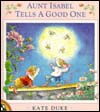
Aunt Isabel Tells a Good One
by Kate Duke

GOALS
By isolating basic story elements setting, characters, problem, and solution Aunt Isabel Tells a Good One shows students the building blocks of a story. This lesson gives them an opportunity to identify and modify these elements as a first step in creating a story of their own. A graphic organizer is provided to assist the lesson. Students should be encouraged to share their work as they develop their ideas. A large-group sharing time provides teacher and students with an opportunity to discuss and assess the final products.
OBJECTIVES
1. Students will learn about the construction of a good tale through a reading of Aunt Isabel Tells a Good One.
2. Students will be able to identify the setting, main characters, problem, and solution of Aunt Isabel Tells a Good One with the assistance of your graphic organizer.
3. To develop their own skills as authors, students will be able to modify the tale by creating a new solution to Aunt Isabel Tells a Good One.
4. Students will be able to share their work with the class.
MATERIALS/RESOURCES
1. Aunt Isabel Tells a Good One by Kate Duke
2. Large paper and marker for webbing ideas (optional)
3. Photocopies of your graphic organizer (optional)
4. Pencils and crayons (optional)
PROCEDURE & METHODOLOGY
1. Prior to introducing Aunt Isabel Tells a Good One, ask students to share with you what they know about making a good story. You may wish to list or web their ideas.
2. Read the story pausing intermittently to ask questions and discuss story elements. For example, Who are the main characters?, Why is it important for Aunt Isabel to add a problem to the story?, or How do you think Lady Nell will solve the problem?
4. Have the students brainstorm a new solution to the story and write it down on a story graph. They can come up with more than one! As they work, encourage them to share their ideas. End the activity with a large-group sharing time. Don't forget to display their great ideas!
5. For ESL and other special needs students: Rather than writing their ideas, they can draw pictures to depict each of the story elements, including their new solution. They can exercise their oral language skills when they share their work!
EVALUATION
Students' work can be evaluated throughout the lesson as well as during sharing time. The lesson provides assessment opportunities in all areas of language arts reading, writing, listening, and oral language.
Possible topics for your Graphic Organizer:
Main Characters
Good / Evil
Setting
Where
When
Problem
Solution
New Solution